The short answer
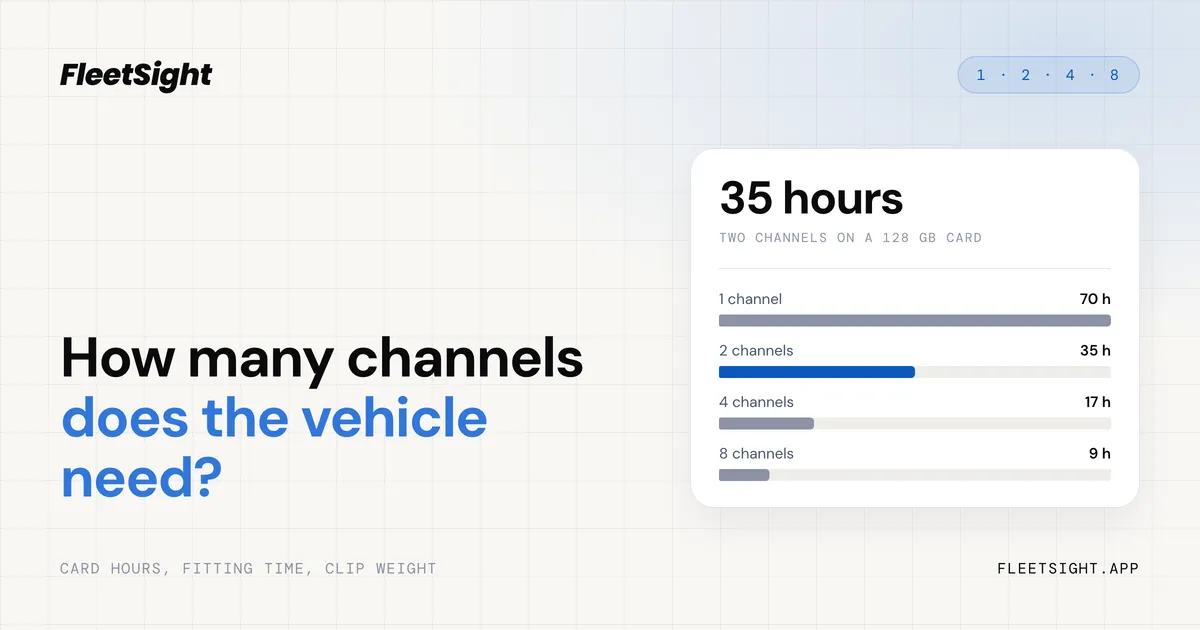
Two channels — road and cabin — answer most van fleets. Four is the honest default for trucks. Every extra channel is a cable run and half the card window: 128 GB holds about 35 hours of two channels at main stream. Start from the incident the fleet keeps paying for, cover that, then add one channel for next year.
The channel count is the first specification anybody argues about and the one that quietly decides the rest of the quote: the fitting time, the card size, the weight of every clip somebody pulls, and whether the fleet can actually answer the question it bought the system to answer. Here is how we pick it.
What a channel costs you
A channel is not just a camera. It is a cable run through the vehicle, a share of the card, and a share of every retrieval.
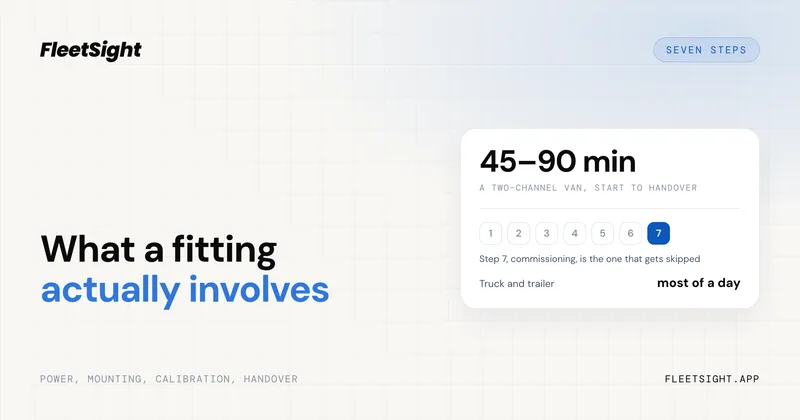
- Fitting time. A two-channel dash cam in a van is 45–90 minutes. A four- or eight-channel recorder with external cameras on a truck and trailer is most of a day.
- Card hours. 128 GB is about 35 hours of two channels at main stream, and roughly twice that for one. Double the channels and you halve the window you can look back through — unless you double the card, which costs about €15.
- Retrieval weight. Clips are pulled per channel. Four channels do not cost four times as much per incident in practice, because nobody pulls all four, but the operator has to choose — which is why the platform shows the size before the pull.
By vehicle
One channel — the road, or one thing that matters. Delivery cars where the fleet only wants the forward view, or a single external camera on a piece of plant. EH21 (4G, one channel) and EH80 (AOV, one channel, 9–90 V) cover it; ES803 is the one-channel AI camera when the point is detection rather than a full recorder.
Two channels — road and cabin, the default for vans. This is the configuration most fleets mean when they say “dash cam”: forward for the incident, inward for the driver. EH26 (two channels, 1080p, H.265), EH24 and EH25 sit here. MR01 is the motorcycle version for two-wheel fleets.
Three channels — road, cabin and rear. Couriers who reverse into loading bays all day, or any operation where the rear-end claim is the one that keeps happening. DR03 is the three-channel unit; note it is H.264 only, so budget more card and heavier clips than its price suggests.
Four channels — the rigid truck and the working vehicle. Road, cabin, rear, plus one of: nearside blind spot, tipper body, cargo area, tail lift. Either EH03T-V2 (four-channel AI dash cam, H.265) if you want one device on the glass, or ED02R-V2 (four-channel AI recorder) when the box belongs under a seat and the cameras are spread around the vehicle.
Six channels — the rigid with a trailer. EH15-V2 does four or six, which is the awkward middle a lot of fleets actually live in.
Eight channels — buses, coaches, refuse, tractor-and-trailer. ED08R-V2. At this point you are building a small CCTV system on wheels, and the questions that matter are card size, where the recorder lives, and who is allowed to pull footage.
Every model above has its own page with the manufacturer’s specification, including the channel layout, the storage options and the voltage range.
Three mistakes we see
Buying channels for the tender, not for the claim. Eight channels on a vehicle whose incidents are all forward collisions is a day of fitting and a halved card window for footage nobody will watch. Ask which incident the fleet keeps paying for, then cover that first.
Forgetting the card maths. A four-channel vehicle with a 64 GB card holds well under a working week. When an incident surfaces ten days later, the footage is already gone — which is not a platform problem, it is a specification problem made at the quote.
Mixing up the DMS camera and the cabin camera. A 140° cabin lens covers the whole cab and is what you want for evidence. Driver monitoring needs a 60° lens pointed at the driver’s face; use the external DMS camera on models that do not carry one, or the detection quality will disappoint everybody.
A rule of thumb
Start from the incident the fleet is actually paying for, add the camera that answers it, then add one channel for the thing that will happen next year. Two channels answer most van fleets. Four is the honest default for trucks. Eight is a decision, not a default — and if you are unsure between four and six, take six now, because the second fitting visit costs more than the two spare inputs.
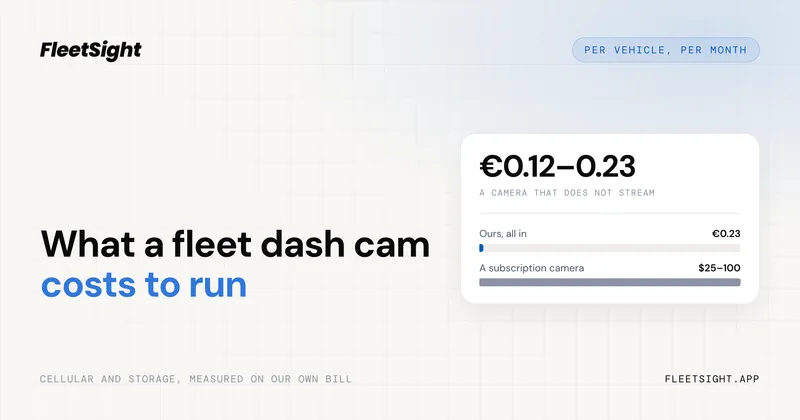
Prices by volume band are on the integrator page, and what all of this costs to run per month is in the running-cost post.